Breaking the Latin Mold
These volumes attest to the ways in which Lucretius’ text was read and reshaped within the context of translation. As the original text is in Latin, translations into vernacular languages played an important role in making the work accessible to wider audiences as it continued (and continues) to be interpreted and re-interpreted throughout history. The most prominent early translator of Lucretius into English is Thomas Creech, who made a living through his highly successful translation of Lucretius’ Natural Philosophy during his lifetime. In this selection, Creech is mentioned more than any other scholarly figure, making him a major point of interest. Translations into Italian, French and Dutch are also featured here — often including prefatory materials from their translators.
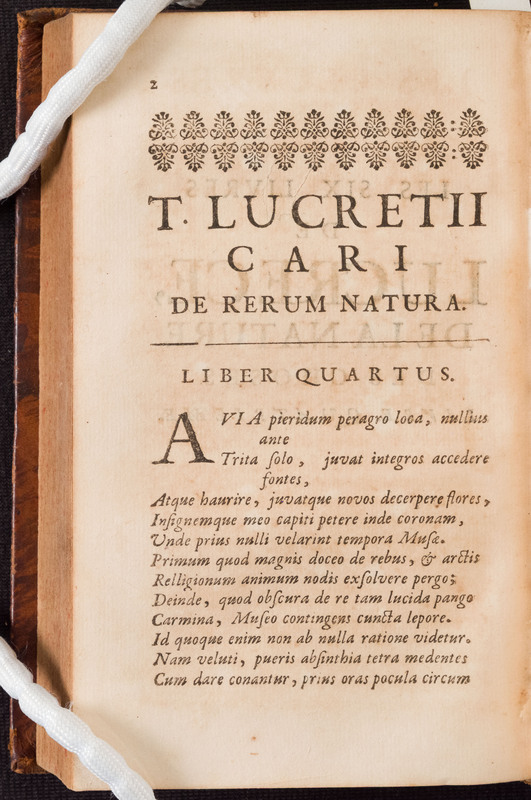
Les oeuvres de Lucrece, Contenant la Philosophie sur la physique…avec des remarques sur tout l’ouvrage (B 10601). This volume from Paris features both Latin and French versions of the text. All six books of the original poem are present. Near the beginning of this volume, Thomas Guillain warns his readers about the exact wording that could have been lost between the languages and meditates on the ways that ideas of the universe have changed between Lucretius’ time and the contemporary understanding of his own day.
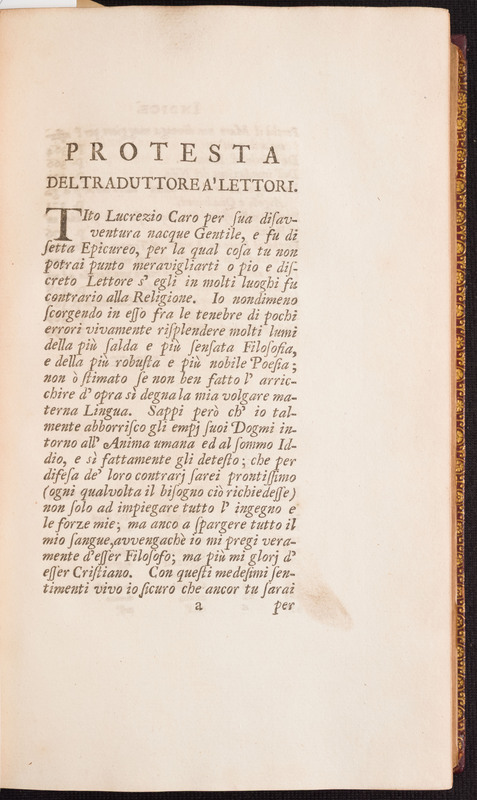
Di Tito Lucrezio Caro Della Natura Delle Cose Libri Sei… (C 0160). This 1717 volume from London, translated by Alessandro Marchetti — a prominent Italian translator of Lucretius — covers all six books of De rerum natura. This edition is significant for it preface and warning from the translator, where Marchetti discusses the tensions between Christianity and Lucretius’ philosophy, since Lucretius was perceived as opposing religious thought. Marchetti writes that this translation was “noble” and “the most truthful to the highly regarded Latin works” — in his mind, this is because the Italian language allows readers to glean more from Lucretius’ writings than the original Latin does.
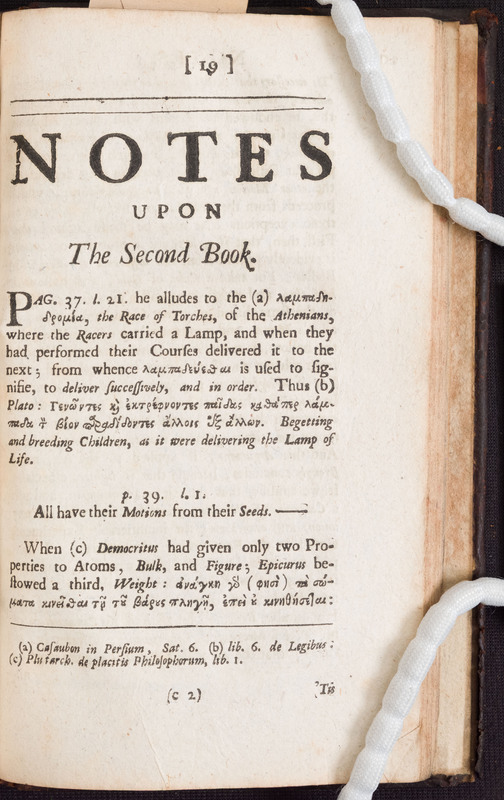
Titus Lucretius Carus, His Six Books of Epicurean Philosophy, Done Into English verse, With Notes. By T. Creech (B 2916). This 1712 volume from Little Britain — an important street for booksellers in London — features the translation of Thomas Creech, a renowned scholar of Lucretius. The book includes many letters to Creech praising the translations and discussing the importance Lucretius’ work held into modernity. There are also notes on all six of Lucretius’ works at the back of the volume, offering further insights into Creech’s thought, along with a discussion of his choices as a translator and the difficulties of reconciling Lucretius with Christian thought (and religion more generally).
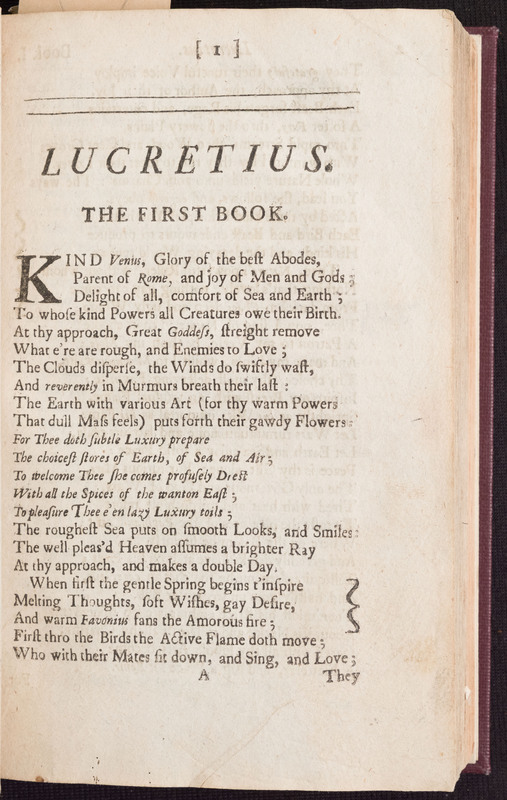
Lucretius, his six books of Epicurean philosophy : and Manilius his five books : containing a system of the ancient astronomy and astrology : together with the philosophy of the Stoicks (B 3451). This 1700 volume from London represents an earlier edition of Creech’s work. The book features some curious errors in the ordering of its contents, suggesting confusion on the part of a past binder. It includes two different English translations (one by Creech, and one by John Dryden) along with the predictable set of letters praising Creech and his scholarship from John Evelyn, Aphra Benn, and other luminaries. Creech’s translation evolved little (if at all) as his career progressed, but his notes were occasionally updated.