Lucretius and the scholarly world
Lucretius and his work were prominently emphasized in early modern scholarship, as evidenced by the many editions of Thomas Creech’s important translation into English. Many of these editions begin with a curated selection of letters addressed to Creech by various other scholars, serving to highlight (not by accident) his renown as an educated translator. Some later editions featured Creech’s translations as a basis for the annotations and ideas of later scholars, whose subsequent notes on the original text give further context to the complex transmission of the work into English. This broad range of textual interactions between Lucretius, Creech, and various intellectual heirs speaks to the ongoing relevance and importance of Lucretius’ work in the scholarly milieu.
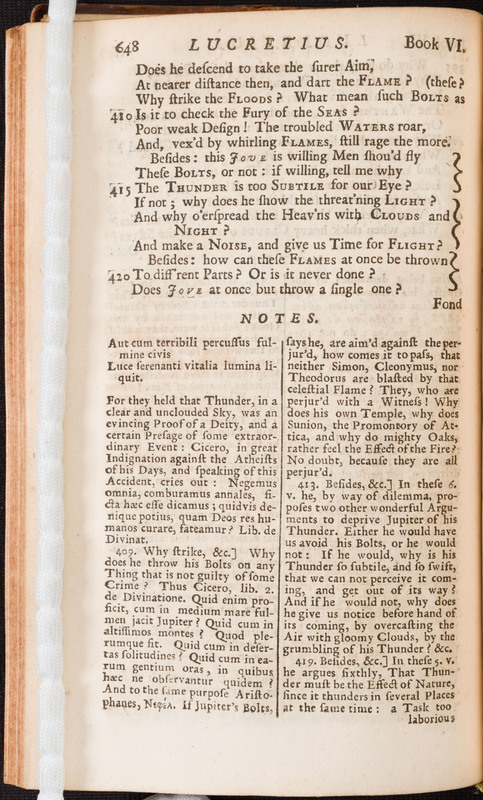
T. Lucretius Carus, of the Nature of Things. Transl. Into English verse by Thomas Creech, A.M. and Fellow of Wadham College in Oxford (B 5373). This 1714 volume, the second in a broader series, invites the general public into the scholarly world of Lucretius through the extensive commentaries of Thomas Creech. In these remarks, Creech complements his translation by delving into theories, explanations, and insights into Lucretius’ philosophy and use of language. This invites the reader to engage with the broader context of the poem, making Lucretius more accessible to a wider range of people. Creech also prefaces each of Lucretius’ six books with his own summary thoughts and critiques, setting the stage for a deeper understanding of the poem as one reads it.
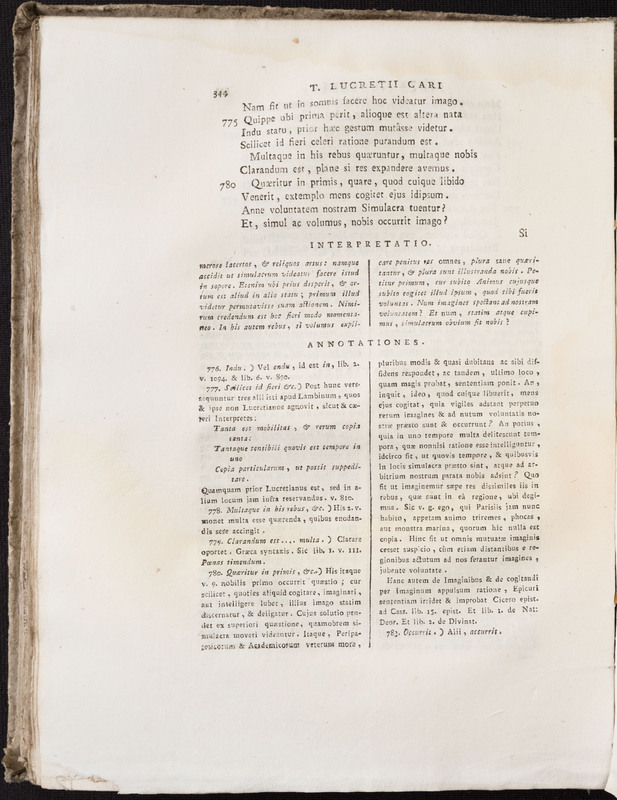
Titi Lucretii Cari De Rerum Natura Libros Sex (D 0939). This 1788 Latin volume, by the interpreter Michael Favus, includes annotations and interpretations covering all six books of Lucretius’ natural philosophy. These discuss Favus’ understanding of the text itself, and accompanying annotations include explanations of terms and deconstruction of the context of the individual verses. This text is followed by an apparently unrelated commentary by another scholar entitled Observations of John Nardius on the Funerals of the Athenians which displays the ways in which scholars were interacting with each other in terms of suggesting further readings and inviting the reader to pursue the presented topics.
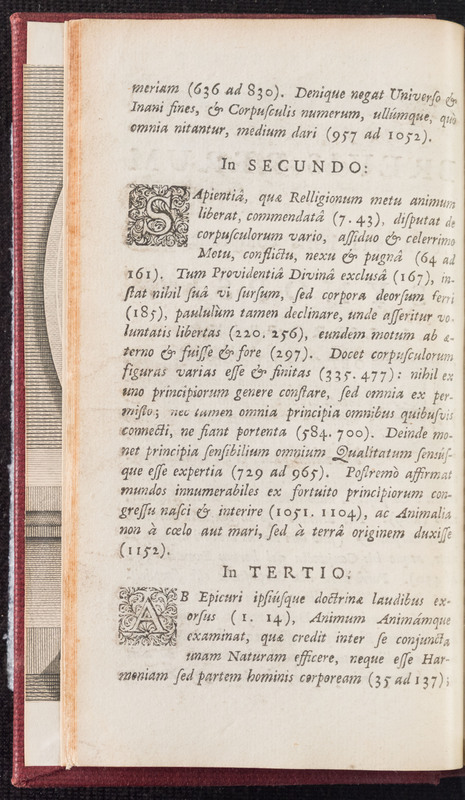
Titi Lucreti Cari De rerum Natura Libri Sex (A 0430). This miniscule 1713 Latin volume came to McMaster by way of Harvard College Library, as attested by a bookplate on the front pastedown. The first few pages of the volume are synopses of the six books from Lucretius, suggesting it was produced to be used in an educational context — a use corroborated by the minute size of the volume, which would have been highly portable and capable of being read while on the move.
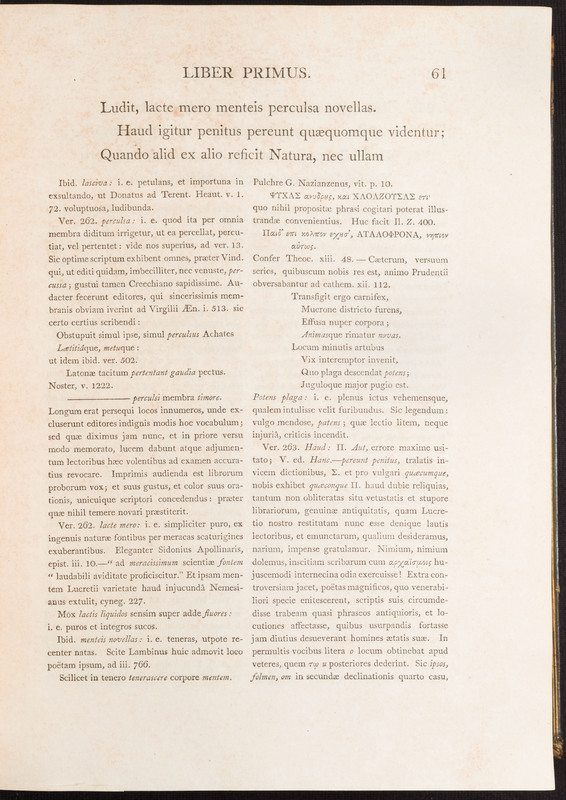
T. Lucretii de Rerum Natura Libros Sex (D 1220). This 1796 Latin volume edited by Richard Bently focuses heavily on analysis of Lucretius’ natural philosophy. Bently includes his argument on what Lucretius is doing in each of his books before beginning the first book of natural philosophy. Within each book, Bently writes extensive annotations on the verses of Lucretius, making bold claims about Lucretius’ intentions and ideas, while citing other ancient and modern scholars to support his educated interpretation and opinions.